

Stage 2 — Initial Fit Call (15 Minutes)
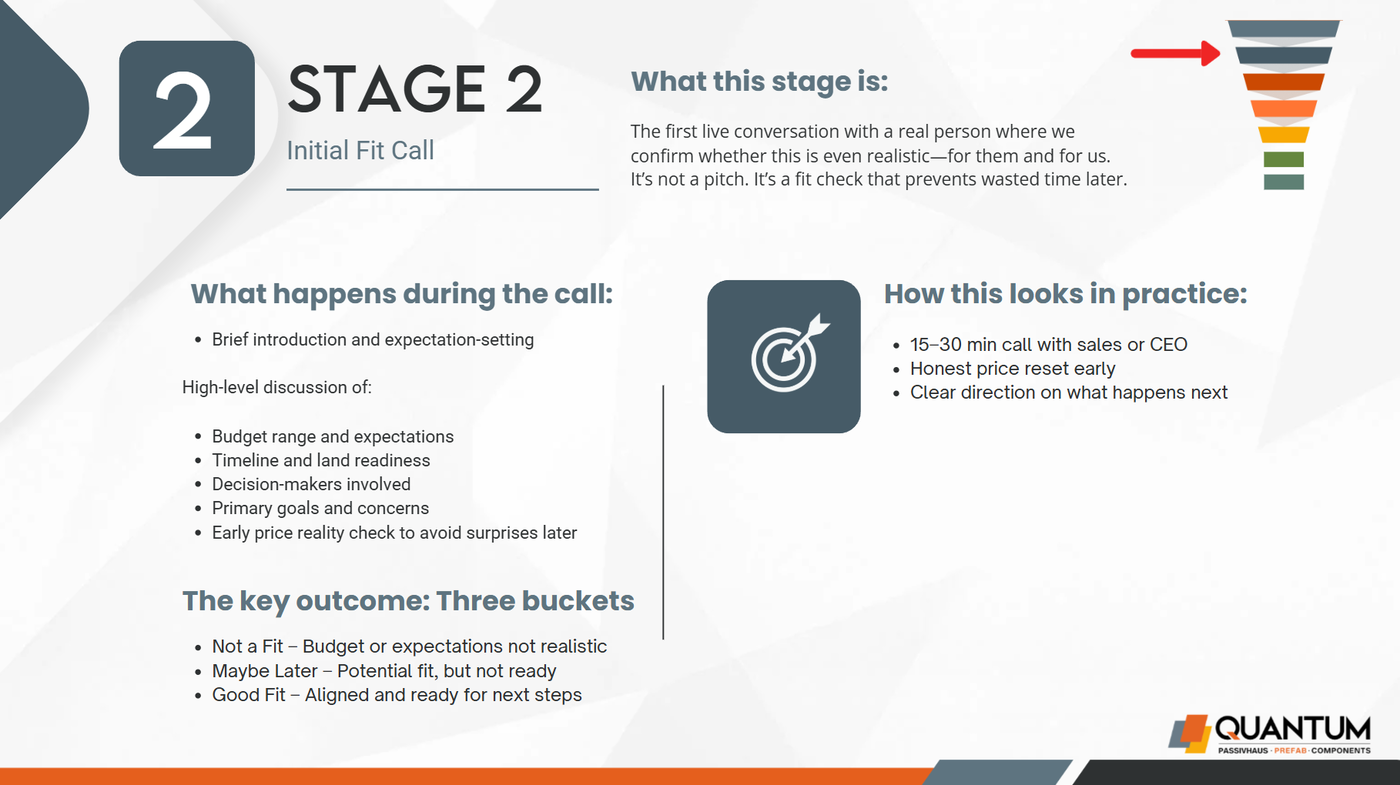
Purpose of This Stage
The Initial Fit Call is the first live conversation with a prospective client.
Its sole purpose is to determine whether a project is realistically viable—for the client and for Quantum.
This is not a pitch.
This is a fit check designed to prevent wasted time, false expectations, and misaligned projects later in the process.
At the end of this call, both sides should have clarity on whether it makes sense to proceed.
What This Stage Is (and Is Not)
This stage is:
A structured but conversational screening call
A reality check on budget, timeline, and readiness
A way to assess alignment before deeper effort is invested
This stage is NOT:
A design discussion
A technical deep dive
A quoting exercise
A commitment to build
Call Length & Tone
Target duration: 15 minutes
Acceptable range: 15–30 minutes (only if high-quality alignment is emerging)
Tone: Calm, human, confident, non-salesy
Approach: Rapport first, structure second
The call should feel casual on the surface, while being rigorous underneath.
Call Structure
1. Opening & Rapport (2–3 minutes)
Objective: Put the prospect at ease and set expectations.
Brief introduction
Confirm time boundary (“We’ve got about 15 minutes”)
Establish conversational tone
Light rapport-building (where are they from, how their day is going, how they found us)
Internal mindset:
We are listening for alignment, not trying to convince.
2. High-Level Fit Questions (8–10 minutes)
This is a guided discovery, not an interrogation.
Questions should be asked naturally, but all categories must be touched.
Core Questions to Cover
1. Budget Range & Expectations
“Do you have a target budget range in mind?”
“Is that a rough range or something more fixed?”
“What are you using as your reference point for cost?”
Optional soft follow-up (only if unclear)
“Is that more of a working range right now, or something you feel needs to be locked in?”
Purpose:
Surface budget reality early
Identify major misalignment quickly
Avoid anchoring to unrealistic assumptions
There are different ways to approach budget
Certainty vs flexibility is a later decision
Numbers will be revisited with structure
What we are NOT doing
No benchmarking
No corrections
No explanation of methods yet
2. Timeline & Land Readiness
“What’s your ideal start time?”
“When do you need the project completed?”
“Do you already have land, or is that still in progress?”
“What’s the current state of the site?”
What this quietly foreshadows
Start and finish dates are different constraints
Land status matters
Timelines affect process
What we are NOT doing
No reverse engineering
No feasibility math
No “that won’t work” statements yet
3. Decision-Makers Involved
“Who else is involved in making this decision?”
“Who else should be part of these early conversations with us?”
“Is anyone else ultimately signing off on the decision?”
Purpose:
Avoid stalled deals later
Ensure the right people are engaged early
This is a considered, multi-step process
Alignment matters later
We expect adults in the room
4. Primary Goals & Concerns
“What’s most important to you about this project?”
“What made you start looking into this now?”
“What are you most worried about?”
Purpose:
Identify true motivation
Understand pain points (time, quality, cost, risk)
Listen for alignment with Quantum’s strengths
What we are NOT doing
No problem framing
No solution positioning
No pitch language
5. Early Price Reality Check
“Have you explored similar builds or approaches before?”
“Have you looked at other builders already?”
“What are you comparing this against?”
“What’s been most confusing or unclear so far?”
Purpose:
Reset expectations gently
Prevent sticker shock later
Test flexibility
What we are NOT doing
No rebuttals
No pricing defense
No differentiation speech
Closing the Call (Last 2–3 Minutes)
Step 1: Verbal Summary (Make Them Feel Heard)
Before advancing, the salesperson briefly reflects back what was captured.
Internal rule:
If the prospect doesn’t nod or verbally agree here, you do not advance.
Example recap (paraphrasable):
“So just to make sure I’ve got this right—you’re looking at a [new build / retrofit], you have a general budget range in mind, timing is important to you, and the big priorities are [comfort / performance / certainty / speed]. You’ve already done some looking around, and what you’re really trying to avoid are surprises and drawn-out timelines. Does that sound accurate?”
Pause. Let them confirm.
Step 2: Transition Statement (Clear, Calm, Non-Salesy)
Once alignment is confirmed, the salesperson takes control of the process.
Exact positioning principle:
This is not “the next sales call.”
This is how Quantum works.
Key Outcome: The Three Buckets
Every Initial Fit Call must end in one of three outcomes.

1. Not a Fit
Indicators:
Budget far below realistic range
Timeline impossible without major compromise
Misalignment with Quantum’s scope or model
Not a Fit Close (30–45 seconds)
“Thanks for walking me through all of that—I appreciate the clarity.”
“Based on what you’ve shared, I don’t think we’re the right fit for this project at this stage.”
“That’s mainly because of the gap between the current budget and timeline and what a high-performance, panelized build realistically requires.”
“I’d rather be upfront about that now than have you invest more time or energy in a process that won’t serve you well.”
“If things change—whether that’s budget, timing, or scope—I’m always happy to reconnect. And either way, I appreciate you reaching out.”
Pause. Stop talking.
Internal Notes (Not Said)
Do not apologize
Do not over-explain
Do not offer workarounds
Do not suggest the feasibility
Clarity is the value here.
Action:
Be respectful and direct
Do not advance to next stage
Offer clarity, not false hope
Tag as “Not a Fit” In Ontraport
2. Maybe Later
Indicators:
Conceptually aligned, but:
Budget not ready
Land not secured
Decision-makers not aligned
Timing not workable yet
Stage 2 — Maybe Later Close (45–60 seconds)
“Thanks for walking through this with me—this was really helpful.”
“Conceptually, this does sound aligned, but I don’t think the timing is quite right yet.”
“There are a few pieces that would need to firm up first—mainly around [budget / land / timing / decision-makers]—before a deeper working session would be productive.”
“What I’d suggest for now is that you take some time to work through that on your end. Once those pieces are clearer on your end, feel free to reach back out and we can see if it makes sense to take the next step.”
“If it’s helpful, I’m also happy to point you to resources or answer a quick question as things evolve.”
Pause. Stop talking.
Internal Notes (Not Said)
Do not book the 90-minute call
Do not imply commitment
Do not push for momentum
Name one or two blockers only, not everything
Action:
Park the lead intentionally
Suggest what needs to change to re-engage
Do not advance to deep-dive yet
Tag as “Maybe Later” In Ontraport
3. Good Fit
Indicators:
Budget expectations broadly realistic
Timeline workable with known tradeoffs
Decision-makers aligned
Clear motivation and readiness
Good fit: Feasibility Framing
Refined Script:
“Okay—based on what you’ve shared, this does sound like a good fit to explore further.
Here’s how we work from here.”
“The next step is something we call a feasibility study. This is not a quote and it’s not a pitch—it’s a working session.”
“We’ll schedule a 90-minute conversation where we sit down together and go through your project in detail. I’ll ask you some more specific questions around scope, budget approach, performance goals, and timing.”
“After that session, we put together a clear, written roadmap that shows exactly how a high-performance, panelized build like yours would move from where you are now to a completed project—step by step.”
“You’ll understand what decisions need to be made, what the tradeoffs are, what affects cost and timeline, and what’s realistic—without any surprises.”
“And importantly, if you decide not to move forward with us, that plan is still yours. You’ll have a clear path you can execute with full understanding.”
Step 4: Set Expectation Without Pressure
Soft but firm close:
“Our goal with the feasibility isn’t to push you into anything—it’s to make sure that if you do move forward, you’re doing it with total clarity and confidence.”
“If that sounds helpful, the next step would be to book that 90-minute session.”
Pause. Let them respond.
Key Notes for Sales (Internal)
Do not oversell the feasibility
Do not talk about contract yet
Do not talk about price detail yet
Speak slowly and confidently
This should feel like relief, not escalation
What This Close Accomplishes
Positions Quantum as process-driven and professional
Makes the 90-minute call feel earned and necessary
Removes fear of commitment
Signals value without hype
Keeps control of the funnel
One-Line Internal Reminder
We are not asking for permission to sell—we are explaining how clarity is created.
Action:
Recommend the next stage (90-minute deep dive)
Set expectation that the next step is more detailed and structured
Position it as preparation for a feasibility study
Tag as Good Fit in Ontraport
Move the lead card to Stage 3 in Ontraport
What Success Looks Like
A successful 15-minute call results in:
Mutual clarity
No ambiguity about fit
No pressure or confusion
A clear next step—or a clean exit
If the call ends and the next step is unclear, the stage failed.
Internal Notes for Sales
You are screening them as much as they are you
Control the clock gently
Do not overshare technical detail
Do not skip the price reality check
Clarity beats politeness
Output from This Stage
Internally, this call should produce:
A concise written summary
Clear bucket assignment
Enough context to prepare for (or decline) the next stage
This summary becomes the input for Stage 3 and Stage 4.